• | Home |
  • | Professional |
    • CV
    • Resume
    • Letter
  • | Personal |
  • | Practical |
  • | Downloadables |
facebook twitter instagram pinterest bloglovin Email

Essentials P.S.


A Grocery Store Prosecco Taste Test: Which Bottle Is Worth Buying?

When you’re browsing the wine aisle at a grocery store or big-box retailer like Target or Total Wine, sparkling wine options can feel overwhelming. I wanted to simplify the choice by comparing several widely available Proseccos—the kind you’re most likely to find almost anywhere.

My goal was straightforward: compare price, flavor notes, and region to see which bottle delivered the best experience for everyday drinking.

What I discovered made this category particularly interesting.

Why Prosecco Is a Unique Category

Unlike some of my previous wine comparisons—like rosé, which spans multiple regions and styles—every bottle in this tasting shared a key distinction. Each was labeled DOC (Denominazione di Origine Controllata) from Italy.

DOC is apparently Italy’s regulated system for protecting regional wine production. In some ways, it’s similar to how the word Champagne is legally restricted to sparkling wine from the Champagne region of France.

That shared classification meant the wines started from a similar baseline. But their flavor profiles varied much more than I expected.

A Surprising Mini Bottle: Coppola

I’ve often thought of Coppola wines as a reliable standard for grocery store wine-good quality without being complex.

But the mini bottle I tried was surprisingly different.

My first impression was a bright, citrus flavor, almost like lime or grapefruit mixed with lemon. It had a sharp freshness that caught my attention. When I checked the bottle description afterward, the official notes were green apple and peach.

That didn’t quite match the citrus profile I initially perceived, but it helped explain the taste. The result was a unique flavor—pleasant, but not the fruit-forward style I expected from Prosecco.

The YouTube Recommendation: Mionetto

I first heard about Mionetto from a YouTube chef who recommended it as a go-to sparkling wine.

As one of my first ever prosecco buys, it turned out to be fruity, balanced, and extremely easy to drink.

The best way I could describe it was this: it tasted like fruit punch—not because of any one fruit flavor, but because multiple fruit notes blended together so smoothly.

The bottle lists golden apple, white peach, and honey, and those descriptors felt accurate. It had just enough sweetness and complexity without becoming heavy.

This ended up being my highest-rated wine in the tasting.

The Advertising Surprise: La Marca

La Marca is heavily advertised, and I’ll admit that heavy marketing sometimes makes me skeptical about quality.

It delivered exactly the fruit-forward flavor profile I had been hoping to find. To me, it tasted like tropical fruit—almost pineapple-like.

Interestingly, the bottle lists lemon and apple as its main notes. To me, those flavors combined have that rich sweetness that pineapple. I think that's what I was picking up.

In the end, La Marca was almost tied with Mionetto for my favorite.

The Most Unique: Kim Crawford

Kim Crawford produced the most unusual flavor profile of the group.

The first thing I noticed was a strong combination of red apple and green apple flavors. The contrast between those two types of apple created a distinctive taste—crisp but slightly sweet at the same time.

However, the bottle notes describe pear and tropical fruit, which didn’t fully align with what I experienced.

Even though it wasn’t exactly my preferred style, the wine really tasted high quality and well-made. I can easily imagine it being a favorite for many people.

Order

This small tasting reinforced something interesting about Prosecco: even when bottles share the same DOC classification and region, the flavor profiles can vary quite a lot.

Here’s how they ranked for me:

  1. Mionetto – Fruity, balanced, and easy to drink

  2. La Marca – Bright tropical flavor with great drinkability

  3. Kim Crawford – Unique profile, high quality

If you’re looking for a reliable grocery store Prosecco, Mionetto and La Marca both stand out as excellent choices.


Share
Tweet
Pin
Share
No comments

Many wine enthusiasts express an early interest in exploring the world of wine. From their early adult years, they often experiment with different bottles and learn what they can about the complexities within. A common challenge that arises when trying many wines over time is remembering which notes were most enjoyable, and how one bottle compared to another. To address this, some have turned to keeping tasting notes, categorizing wines into price ranges for easier comparison.

The main categories considered here are rosé, red, sparkling, and white. The focus is specifically on what might be called “grocery store wines”—those widely available at standard grocery stores, chains like Trader Joe’s, Target, Walmart, or even drugstores. While smaller boutique shops may offer excellent selections, the goal here is to identify reliable, accessible options. For rosé in particular, the aim was to find bottles that could be easily picked up on the way home, chilled, and brought to a gathering, barbeque, or casual evening. Many consumers begin with bottles under $9.99, seeking something simple, refreshing, and affordable—especially before a higher income makes splurging more practical. Rosé is often seen as a light, approachable summer wine that doesn’t require overly serious tasting rituals. Wines perceived as overly cheap or poor in quality were excluded, though many under-$10 rosés remain available for future exploration.

Among the bottles surveyed were Dark Horse, Emma Reichart, Charles Shaw (Trader Joe’s house brand), La Ferme Julien, Open Skies, Apothic, and La Vielle Ferme. Notably, none of these were considered outright bad. Each was ranked on a 1–10 scale, with the understanding that wines around $15 are often thought to represent the sweet spot for value and quality. Unsurprisingly, none reached the very highest tier, but several delivered enjoyable and well-balanced results within their price range.

Rosé is generally expected to be bright and light, with notes of red fruit such as strawberries, watermelon, raspberries, or cherries. Some are tart, some acidic, and others mellow. Many tasters favor brighter, more acidic profiles, though a mellow, medium-bodied rosé with watermelon notes and low acidity is sometimes preferred. Open Skies rosé emerged as a standout in this regard. It has been praised for its mellow character, marked by natural watermelon and floral rose notes with medium sweetness. The dark pink color and sleek, modern label add visual appeal, and the cork closure provides a classic touch. Beyond taste, its presentation makes it an attractive choice for gatherings or gifts—all for $8 at Target. However, one caveat is its limited availability; as a newer brand found only at Target, it may quickly disappear, as happens with many wine labels.

By contrast, La Vielle Ferme is one of the most consistently available rosés, stocked at grocery stores, Target, and Walmart. Its wide distribution makes sense after tasting: it is considered a reliable crowd-pleaser. While some reviewers rated it lower due to its relative mellowness, it occupies a middle ground among brighter rosés. Its defining characteristic is a raspberry note, which provides a balanced alternative to the sometimes clashing mix of strawberry and watermelon flavors. This lends it a slightly more sophisticated profile and a sense of higher quality. At $9.99, it sits at the top of this price category, though frequent sales bring it down to around $8. Its versatility makes it an excellent choice both on its own and as a base for sangria, where the raspberry note can be enhanced with fresh raspberries, simple syrup, or raspberry liqueur.


Share
Tweet
Pin
Share
No comments
Example of a Trello board being used for a personal schedule. A Trello dark ocean waves background is behind and icy image for the minimum daily schedule list of times and tasks.
Since sticking to a schedule can feel strict and sometimes inconvenient, a 'minimum' schedule can be used as a way to keep the comfort of freedom of time while balancing the basics. There are often a few things we make sure we do in our day that can guarantee a minimum level of health, handling responsibilities, and progress.
One of the changes in adulthood that can be very helpful is getting on a consistent sleep schedule. There are usually two problems with this: not having the freedom to stay up late for special occasions and not allowing for sleeping in when extra rest is needed. A 'rough minimum' could be setting the latest time for sleep and earliest time for waking up (barring logical things like staying up for New Years or waking up early for a flight). This way, it's encouraged to at least aim for a range of times. For example, instead of a typical time of going to sleep ranging from eleven at night to 3 in the morning, it might be eleven at night to one in the morning. In the case of waking up within certain time ranges, instead of it ranging between seven for some mornings all the way to twelve in the afternoon for others, having it range from eight to ten would be a gentle enough waking time. For example, if the latest bedtime is one in the morning, then waking at ten would mean allowing for up to nine hours of sleep, but even getting up at eight would be at least seven hours of sleep. It can be easier to keep a sleep time range than a sleep schedule, and therefore more likely for your body to get stable sleep. Naps can also be incorporated. Instead of sleeping in for five hours on the weekend, a minimum schedule could allow for two hours of sleeping in, with a three-hour nap in the early afternoon.
Morning routines are often pushed to be complicated and thorough, but on our less disciplined days, having a few minimums can help us practice habits that are important to us and help ourselves feel more pulled together on messy days. We all have our basic things we tend to skip over that can be good for us and beneficial for the rest of the day. For example, breakfast. If there's a habit of skipping breakfast, a good minimum could be keeping small bites to eat, leftovers, or snacks to take one to two bites of before leaving. If there's a goal set to meditate every day, shrinking the time down to one to two minutes can help at least make it a habit. If necessary, keeping to the basics such as showering and brushing teeth can take priority over everything else.
Having pre-work or school practices can be a way to gently keep habits that help set the day. Getting organized, preparing, or thinking about the most important tasks for the day can help remove a lot of stress over the hours to come. 
Balances of comfort of structure and provide the need for stability without the drool of discipline and the rebelling against discipline to lead to no schedule at all. Whether at home, resting on the weekend, or on vacation, having a consistent minimum schedule can help make stability an easier goal. Celebrating the repeats of even the smallest practices can assist our likelihood to do the same in the future. So can doing whatever we can to make those minimum steps easier. The health of our sleep schedules and body clocks can be helped along with gentleness. For example. using a sunrise alarm clock and allowing adequate time for each day to start off stable before all else hits. For the weekends, maybe allowing for an extra ten minutes to just get out of bed. For work schedule changes/time zone changes, trying to stay around the same time range makes these adjustments less to think about. These are ways to compensate for the times we don't feel like taking care of ourselves. Exercise dropping down to stretching. Hand cooked breakfast turning into a granola bar. It promotes healthier practices than nothing at all. Taking steps to take care of ourselves makes us feel more pt together and organized setting a better tone for each day.


Share
Tweet
Pin
Share
No comments

 Formally keeping track of a monthly budget over time helps to keep clear on your spending patterns and your financial history. At worst, it means having to write costs that are frustrating to think about and plan for, but at best, it's a way to see yourself being more organized and responsible. Having an aesthetically pleasing simple monthly budget to repeat gives peace of mind for having a solid record of your finances. One step is to just keep track of what your income is and how much you are spending and where. Here, a clear and proper budget breakdown is available for download. There are a few notes on the method used for this spreadsheet.

Download Here. EPS Budget Sheet.


Download Here. EPS Budget Sheet.

One strong rule of budgeting for each month is a rule of thirds. In this method, your housing is within one third of your monthly income, your expenses are kept to less than a third of your budget, and this way the last third is potential savings and investment income. 

For housing, likely the most essential part of a monthly personal budget, having it only cost a third of your income insures that, if times are harder, there is still enough of the budget available to devote to your place of living. This way, the most important thing is more likely to be taken care of. When applying to apartments, for example, they might want applicants to make three times the money of whatever the rent would be. In many cases, finding a residence where the cost is only a third of the average person's monthly income is difficult. The times of a person's income being able to match that rule in the current day housing market is becoming rarer.  Still, it is a good rule to aim for. This is considering all forms of housing: renting a room, renting an apartment, having a mortgage, etc. Also in this consideration are expenses that come with the housing. For example, mandatory renter's insurance, HOA fees, attached trash billings, etc. Often, an evaluation of whether or not to move out of a parental home might be if someone makes at least twice what their housing cost will be. There are exceptions, such as unusually high housing areas. For example, if your expenses are a very small fraction compared to how much you make, and you can afford to allocate more of your budget to housing. Within the housing budget, I include any separate storage fees, cost of PO boxes, if necessary, etc., as well as the expectation of potentially increasing costs such raised rent or increased property taxes on a yearly basis.

Bills are categorized here as any regular bills and cost such as electric (as well as water, sewer, and trash if not separated from the housing bill), internet, cell phone costs, car payments, and more. It's an area I would charge to things like subscription services or gasoline as well. In this budget sheet, bills are separated out from other expenses such as groceries and personal care items to split the budget into four sections instead of three. Their ratios can be very different.

It leads to the last third or fourth of a person's budget to being used for miscellaneous fees, whereas much of that is possible can be used for savings, retirement and more. Even here, further breaking miscellaneous into a fractional budget can help. For example, a third going to savings, a third going to safe investment, and a third going to retirement funds. There is a lot of variation that can be done especially here. There will also probably be changes continuously over time. For example, 100% of it could go to savings until there are 2-3 months of expenses saved in case of an emergency. Then, maybe 75% goes to debt such as student loans and credit cards and 25% to retirement. Maybe 50% goes into a separate savings for a new car, or a condo down payment.

Here are a few notes about the spreadsheet:

  • Have the google sheet set to 75% zoom to best see all the details in a quick glance.
  • The grid lines are off. They can be turned back on to better see the cells by going to View->Show-> and then selecting grid lines.
  • The font is cormarant garamond font with a default size of 12pt.

Download Here. EPS Budget Sheet.
Share
Tweet
Pin
Share
No comments

Process

The way I've approached moving, and learned from it, has made me focus on a few specific things. First, is to nearly 'move' as much as you can as soon as possible. I, and everyone I've helped moved before, has underestimated what it takes to move. All of the packing, deep cleaning, and breaking down of big furniture you can do far in advance. Also, ensure the finalization of moving out and moving in. Apartments often need 2 months' notice in advance, for example. It's good to do three if you can and if you've already decided by then. Some people wait to see their new lease price offer, which might only come in 2 months in advance. Apartment moving in has move in dates. Your rent will probably end up overlapping in order to have time to move from one place to another in a couple of days, which brings the third focus: budget. Buget money for the overlapping rent or mortgage and closing fees, budget the cost of moving of boxes an extra gas or post office or U-hauls. Changing your utilities over, you might want to have your utilities run over for both places while you move. This way, your fridge and air conditioner or heater (depending on your location and weather around that time of the year) are available while moving at both residences. Buget the time it will take to move. So, fourth, budget your energy and strength. Moving leaves you sore over the next day. Not much is worse than having no energy, arm strength, or time to move on your last day and having to 'figure something out'. This is where asking friends a week or two in advance to help you move can really make a difference. Pizza is the typical appreciation gift. Healthier options are great too. Like a crudité board, plenty of water, maybe juices or electrolytes to help with the sweating, and a full meal like a light casserole, etc. Anything non-heavy since this is basically a 'post workout'. Keep in mind that your helped movers may need help one day themselves, and you can repay the favor.
This is assuming that I'm moving out of an apartment, for example, and into another. In the process of buying a house or condo or selling one, that is a much more paperwork heavy process. Even just moving in with new roommates or with your parents again for a while means taking care of your affairs at what will soon be the old residence and getting the new one prepared. I've found this a good time to record your address. I started recording my addresses of residence when asked in special paperwork or identity confirmation cases to select my previous residences. It's been useful since I tend to forget thigs like apartment numbers, or even housing numbers if your back house A for example, and also, I tend to forget the zip codes and even extended zip codes for total accuracy. You can use the address record template here. 
Keeping a list of things to buy for moving out or moving in like lightbulbs, cleaning supplies, wall patching kits, paint, bait, etc. will be useful. Remember to air out the living space if the new home has not been occupied for a while.
Also, things like forwarding your mail, or having a hold at your mailbox if the new one is getting fixed in the age of broken into mailboxes is something to consider.
A U-Haul might be useful.
For moving overseas, or far away, the post office flat rate boxes are amazing. They are good for the heaviest of compact objects. For example, books.

Overall Timeframe

  • Decide whether or not to move.
  • Do paperwork for both residences as needed. Moving in with roommates or even parents, make sure you have your agreements sorted out.
  • Give notice to move in advance. If you have a landlord you communicate with regularly such as a house rental, letting them know far in advance can be helpful for them to plan accordingly. For example, if you know in six months, you will move, let them know informally via text or whenever you see them that you'll probably move (this is to be safe in case something comes up and you change your mind), and then formally two or three months before over email/text. Another way is to informally inform the landlord about 3 months prior that you will likely be moving out, then two months before, state whether or not you've for sure decided to move out and ask if there is any check out list.
  • Asking to Leave Your Lease Early: usually, breaking a lease is a bad thing. You get charged greatly for it. You are expected to pay for the entirety of the lease. You may even encounter a fee, but if you know you can move into the new residence before the ending of the lease, you could always ask what works best for the landlord or management. For example, let's say your lease is up January 1st, 2025, but you can move into your new place as of November 15th, 2024.  If your current monthly payment is $1,000 a month, but given real estate increases, the demand for a place like yours is now $1500 a month, instead of getting $1000 for December, assuming there is a large move in market, it might be better for your landlord to let you end your lease early and set up a move in for someone else December 1st who will pay 500 more. This is assuming a good market for them where they could nearly grantee renting it out. I bring this up as we recently passed, as a fast-growing city, an enormous increase in the amount people were willing to pay for current residences. In my case, it nearly doubled and move in dates were being agreed to in 3 days rather than 3 months.


Major Strategy


There is a lot to consider when preparing to move. Once the decision to move residences is made, details such as time frames and to-do lists come to fruition. The following are some considerations to make that can make the moving process a bit more efficient, cheaper, and possibly even enjoyable:
______________________________________________________________________

Finish Securing the New Residence | Clean and Pack | Inspect, Move, and Setup While You Go
______________________________________________________________________

Planning

Plan ● Clean ● Pack ● Move
  • Identify how much time you have to move, how much time it takes to get from the first residence to the second (and back while considering avoiding bad traffic times), 
  • Decide on the timeframes, deadlines, and priorities for the steps to moving.
    • Timeframes such as, how much overlap you have overlap between when you can move into to the new place and when you need to be moved out of the old one,
Note: Start packing as soon as possible and start cleaning even sooner.
  • Once you plan on moving, start saving all delivery boxes. Save money by using left over Amazon, Hello Fresh, etc. boxes for packing. This way, you don't need to spend as much money on buying new moving boxes. Even if you think you can move with mostly some tote and trash bags, saving the boxes you'll already have is useful since they're protective, fitting for anything geometric, and stackable.
  • Consider using tote bags, old boxes of supplies like for blenders, etc.
  •  Packing things like toothbrushes, toothpaste, etc. into a cosmetic bag then everything else can be boxed or bagged and labeled. In the two months, theoretically you can still pull out your uncommon items. Just fold the tops of the box in overlapping fours instead of taping.
  • I've seen people who kept their appliance boxes. For example, blenders have weird enough shapes and sharp enough blades to hold themselves.
  • Start deep cleaning asap in order to minimize last minute cleaning.
  • Is your home address the same as your physical address and as your mailing address? These are not always the exact same. For example, if your condo complex occupies multiple streets.
Plan ● Clean ● Pack ● Move
To-Do List
Clean the Bathroom
  • Scrub the shower/tub, toilet, and bathroom sink in advance. When you get closer to the move out date, clean them again, but now this will take far less time and elbow grease. Most of the tasks being done in advance once is meant to cut down on the energy it will take when it is time to move. That's when stress is highest, arms are tired for days from carrying boxes, and time is short.

Share
Tweet
Pin
Share
No comments

A P A R T M E N T  S E A R C H  S P R E A D S H E E T

Apartment Shopping Comparison Guide

ePS Apartment Search Spreadsheet Page 1

The Apartment Search Spreadsheet is a copy-able Google Sheet for managing apartment shopping all in one place.  Sections include what the user is looking for, their budget, and the details of each apartment being considered. Each apartment specific sheet has entries for the address, number of bedrooms and bathrooms, size in square footage, rent cost, mandatory fees like for pest control and renters' insurance, how long of a commute it would be, and checkable features such as if it has a walk-in closet or a patio exposed to sunlight for gardening. The user can add their own cells about school districts or public transport accessibility. The first page tracks when and where the apartment search is taking place. The second page is for entering goals, plans, necessities, and wants. The third page and onward are for each apartment under consideration. Go into 'print' mode to have each of the apartment choices pages next to each other for comparison of pros and cons.

Download Here

Apartment_Search_Spreadsheet

H O W  T O  U S E  T H E  S P R E A D S H E E T

The first sheet, 'The Plan', is for the basic information and purpose for the apartment search. Edit the text by double clicking on the words. Edit the images by selecting them with one click and right clicking for options. The general approach of search organization in the spreadsheet is identifying the:

Who:  ex. An individual, Roommates, a family looking for a good school district, etc.

What: Within the city, across state, or change of country, etc.

Where: Current Location vs. Location of Search

When: General Date of the Search and Move, ex. 'The 2023 Move Across Town'

Why: The Purpose of the Move: ex. To go from the city to the suburbs, for a new job, to downsize , etc.

How: Budget, Requirements, and Timeframe

The right side is for including an image of the general area of search like a screenshot of a zoom-in on Google Maps.

The second sheet, 'The Goals', is to set parameters such as city, area, number of bedrooms and bathrooms, costs, and commute times. Specify what is being looked for, what is wanted, and what would be extraneous.
ePS Apartment Search Spreadsheet Page 2

The third sheet, 'Choice No. 1', is the first sheet for an apartment checklist. It is meant to be duplicated for each apartment being considered (Choice No. 2, Choice No. 3, etc.). Change the features in the left-hand column as applicable.
ePS Apartment Search Spreadsheet Page 3


Go to 'Print' the spreadsheet to compare each apartment sheet side by side.
Share
Tweet
Pin
Share
No comments
Roadtrip Checklist | Things to Check and Pack for a Short-Term-Less Than a Half Day-Roadtrip |
Roadtrip Essentials and Packing -Vehicle Maintenance Practices, Safety and Emergency Supplies, and Extras for a Daytrip or Less Roadtrip without Extreme Weather Conditions


Waco Suspension Bridge, Waco, TX

Advance:
  • Top Off Car Fluids: Oil, Power Steering, Coolant/Antifreeze, Windshield and Wiper Fluid
  • Check the Windshield Wipers, Headlights, Brake Lights, Tire Tread, Tire Pressure, and if an Oil Change is Needed
  • Extras: Vacuum Car, Drop the Back Down, Address Engine Check Lights, Start with a Full Tank of Gas, and Pack a Filled Gas Can
Brazos River Train Arch

The Day/Night Before:

⦁ Exercise to Avoid Cramping During a Long Drive
⦁ Fill Up the Gas Tank in Advance
⦁ Ice Water and Coffee in Advance
⦁ Pack Travel Bag: Clothes, Shoes, etc. Do Laundry as Needed
⦁ Charge Cellphone and Portable Charger
⦁ Pack Food

Checklist/Pack list for the Day of:
  • Keys, a Fully Charged Phone, and Wallet
  • License, Registration, and Insurance
  • Passport/Visa if it’s a Day Trip Across a Border
  • Cellphone Charger: In-Car Charger and Wall Outlet Charger
  • Downloaded Map (Google Maps Can be Downloaded for Offline Use)  
    • Optional: Change the Trip Odometer
  • Useful Things to Have: Handsfree Phone Mount, Cash & Coins for Tolls/Parking meters/etc, Sunglasses
  • Useful Things to Pack: Gas Can, Jumper Cables/Self Jumper, Spare tire + Tire Replacement Kit and or a Tire Repair Kit, and a First Aid Kit
  • Useful Things to Do: Consider Gas Prices Changing Along the Way, and Check Travel Time Estimates for Days and Times of Week to Avoid Traffic Bottlenecks. For Comfort:
Extras:
  • Water, Water, and More Water
  • Coffee
  • Fresh Healthy Food Not from a Truckstop Gas station
  • Comfortable Shoes and Clothes
  • A Set Podcast/Playlist
  • Hand Sanitizer, Wet Wipes, and Paper Napkins as Needed
  • Something for Neck Support


Share
Tweet
Pin
Share
No comments

 Download here.


Share
Tweet
Pin
Share
No comments

 Curriculum Vitae

A CV, or curriculum vitae, is a bibliography of your own history in your profession. 

Here, the citations are captions of each project and references are to the different jobs you have done.

It acts as a portfolio but for professions such as writers, researchers, architects, and software developers instead of artists.

Each job or work done is listed as a one sentence summary.

For example, Stephen King would have a section on his CV for books he had written, another for books he contributed to, and another for feature films he had worked on in relationship to being an author.

A researcher would list each journal publication they appeared on and each mentorship role they've had.

Coders would list their software's, and architects would list their designs.

All of it acts as documentation for yourself on what work you have done, and it is to be updated with time: your education, professional focus, projects, published work, achievements and awards, rewarded grants and funding, invited talks and article interviews, professional memberships and services, teaching and outreach, and more.

It acts as a portfolio for numerous projects, published work, and achievements, or an accounting of work experiences, qualifications, and education.

They are the detailed follow-ups of resumes.


Download a copy of the template here.

Share
Tweet
Pin
Share
No comments


For a traveling checklist of just essentials, click here.

Below is a list of additional items and considerations that could make travel smoother.

1. Downloaded and Signed-In Apps of the Relevant Airline(s)

Airlines are depending more and more on their apps being a one-stop shop for customers. While having printed tickets, an eye on departure boards for delays, and an ear open for gate changes are always good things to practice, necessary information is becoming available faster on respective apps. Important features include:

  • Boarding Pass(s) and Confirmation Numbers
  • Updates on Delays, Cancellations and Gate Changes
  • Updates of Where Your Plane is Coming From
  • Wi-Fi and Flight Entertainment Ease of Access
  • and, particularly, a saved credit card. Post-COVID, many airlines have maintained a hands-free payment system for any necessary In-Flight purchases.
2. Adapters

  • Some airlines have three prong charging ports, for which, power adapters that connect a plane seat's outlet to a USB connection is can useful to have.
  • Avoiding connecting wireless Bluetooth earphones over airplane mode, headphone adapters can be useful for a physical link to listen to music or movies and can easily be switched back and forth from a cell phone to a laptop.
3. Setting a Reminder to Bring Back Gifts

Especially when traveling somewhere new, if you want to bring back small gifts for friends, family, or coworkers, a reminder set daily can help keep the mind open to ideas. Setting one in the morning is a reminder to keep an eye out for good gifts during the day. Setting one at night is a reminder to look back on the day for anything you may want to go back for.

Share
Tweet
Pin
Share
No comments


    Practicing for a job interview with the most common interview questions is a good chance to reflect on why you want the job, how it could meet your overall goals, and how good of a fit it could be for you. Often times, job interviews are given from the perspective of the company: How would you be a good fit for us? In reality, no matter your work experience, education, or history (or even lack thereof), you have a lot to offer in terms of labor, skills, and ideas. Job interview rehearsal is a really good time to pause and realize this is your career and to flip the narrative. The number one question asked helps cover those bases.

    What do you want to do? Why do you want to do it? What are you hoping to get out of this? What do you think you bring to the table for this position and company? How would you want to be in this company?

    Answering job interviews questions first, and thoroughly, to yourself helps form a clearer idea of your goals and to form a plan of action.

 Tell me about yourself?

This is the most common interview question and typically the hardest. It's vague and opens the doors to a medley of chances to communicate your abilities to the interviewers.

How to answer the question:

This is not the time to go into a life story of any sort. What the interviewers are asking are: If we hire you, who are we hiring? 


    -What kind of employee would be entering:

    Are we getting an early career, inexperienced but willing to learn type of employee? Are you a high        school graduate looking for experience? Are you someone drastically changing careers from                   something like racecar driving to Dental assistant? We're you a stay-at-home parent the last fifteen          years and are you looking to reenter the workplace? Are you applying here, because it's the next step      in your career?

    The best way to answer this aspect is to describe where you are at so they can 'meet you where you        are'.

    Ex. I'm a recent college graduate looking to get an entry position into my field of study.


    -What are you looking for? What are you trying to do?

    Here, you can elaborate on the direction you're looking to go in.

     Ex. I'm looking for a long-term secretarial position. I'm interested in business administration and             management and am looking for a position that I could settle into for the foreseeable future.                 Organization and personal management are strong skills of mine, and I think I can use them best         in a secretarial position.

    Ex. I'm looking for a position as a retail sales representative. I have experience in retail sales already         and am looking to move further up into management. I would like to in the next couple of years             move into a store management position.

    Ex. I'm looking for a job as a substitute teacher. I've been in education for four years now. I used to             teach kindergarten and first grade. My spouse is now in the military, and their job requires us to             move every two to three years. Due to this, I'd like to apply my education skills in a support form.


    -What surface level personality do you have?

    Interviewers have a team's dynamic in the back of their mind. For example, if the workplace is an open office with constant team work, a solitary, quiet person who does better working by themselves. It's important to note that this shouldn't affect your answer. Who and how you are should only be used as a mental heads up, in case you are hired, on finding the best approach to help you integrate into the team. No matter the case, all personalities and personality traits have benefits to being added to a team. In the same case given, having a more solitary worker will bring balance to a strong team dynamic.

This is a good place to list your outward and inward personality traits that will show through most plainly at work.

Ex. I'm a bubbly, talkative, social person who like to have focus and positivity to get the job done fast.

Ex. I tend to approach work by learning as much as I can on my own before executing the actual work and communicating with others or asking questions.

Ex. typically do any research, planning, and preparing on my own. I like to do deep dive background checks into what I'm doing and what the best way to do it is. Then, I'll bring it to the team, or whoever in the job it might apply to. I run it by them for feedback, implement it, and bring management up to date. I like things orderly and to a 'T'. Quality and consistency are important to me.

    This communicates being detail oriented and strategic. They now have a better idea of this person's personality traits and work style.

Share
Tweet
Pin
Share
No comments

 STEM Related Example Resume 

Template Available here.


Example Resume

Share
Tweet
Pin
Share
No comments
A Professional Document Template for Needs Such as: Cover Letters, Letters of Resignation, and Memos.


Download by clicking the link: EPSProfessional Document Template

This matches with a downloadable resume posted to this site as well.
Share
Tweet
Pin
Share
No comments


Vehicle Record Keeper Template Preview

For Keeping Track of Previously Owned Cars and Other Vehicle's Identifications, Mechanical Work Done, and Address History

Download It by Clicking the Following Link:

Vehicle Record Keeper Template


Share
Tweet
Pin
Share
No comments

Cleaning Reminder List

Cleaning List

Daily

  • Make Your Bed

  • Sweep Floors

  • Refill any Kettle/Teapot/Coffeepot/Keurig Water Dispenser

  • Wash Dishes and Wipe Down Your Sink

  • Wipe Down Your Stove after Using It

  • Check and Read/Shred Your Mail

  • Organize and Clean Your Work Bag

  • Place Spent Clothes in Your Laundry Basket

  • Take Out Accumulated Trash

  • Main Goal: Clean as you go.

Weekly

  • Mop/Swifter/Wash Floors

  • Do Laundry: Clothes, Bed Sheets, Pillowcases, etc.

  • Scrub Toilets

  • Dust Furniture

  • Vacuum any Rugs or Carpet

  • Take Out Deep Trash: Deep Fridge Cleaning, etc.

Monthly

  • Clean Inside of Appliances (Fridge, Oven, etc.)

  • Clean Doors, Windows, and Mirrors

  • Deep Laundry: Bedding, Shower Curtain, etc.

  • Wipe Down Outside and, as Necessary, the Inside of Cabinets

  • Scrub Backsplash/Grout

  • Wipe Down Baseboards and Vents

  • Wash/Disinfect Garbage Can

Seasonally

  • Clean Out/ Inventory Pantry
  • Clean Out/Inventory Fridge and Freezer

  • Wash Drapes/Wipe Down Blinds

  • Clean Out/Inventory Closets

Share
Tweet
Pin
Share
No comments

You can download it by clicking on the following link:

ResumeTemplate


Share
Tweet
Pin
Share
No comments


This is a travel checklist to go through to ensure the most important things are not overlooked when traveling and also for trying to minimize inconvenience's during travel.

The Most Important Things to Have:

1.Keys

2.Cellphone

3.Wallet

Just as when checking before you walk out the door, these are now more important than ever to check are on your person just before walking out the door and locking it behind you as you leave for a lengthy period of time.

If You Are Flying or Crossing the Border:

4.Passport/ Visa/ Birth Certificate/ Social Security Card

Extra forms of identification are an extra safety net. Check to make sure your main form of identification is valid. For when things like an expired driver's license or ID past 30 days expired come up, having this extra identification can be a saving grace. Just be sure to keep them safe and on your person.

In General, and as Needed, Ensure Packing Includes:

5. Medicine
Prescription Medications, epi pens, etc. Even pain medicine.

6. Toothbrush and Toothpaste. Including toiletries like deodorant, feminine products, extra hair bands, body wash, and body lotion. If traveling by air, only carry up to 3 ounces of each liquid.

7. Clothes

8. Phone Charger

9. Laptop

10. Earphones or Earplugs

11. Water/Snacks/Instant Coffee

Make sure your phone and all devices are fully charged or as close to it as possible. The latter is for the on-the-go speed that often comes once landed where there will be no time to get things like coffee.

To Ensure Convenience:

12. Have travel app downloaded.

13. Check In for Travel Early

14. Check Bags During Check in as Necessary

Number 10 allows for convenience when boarding if flying. Number's 11 and 12 will save time at the airport if necessary. You will want to know, or have easy quick access to, your confirmation number if flying if you are checking in and checking bags at the airport.

For Home Care:

15. Set Emails to Auto Reply as Necessary

16. Take Out the Trash

17. Close the Windows

18. Ensure any food in the refrigerator or freezer that will spoil in the time of absence is dealt with.

19. Turn off the Water/ Unplug the fridge and leave the doors open .


If traveling for business, thirteen is not necessary, but taking out trash that would otherwise stink quite badly when returning home and closing windows where rain or gusts of wind can flow through is helpful for the return. The latter is for when traveling for great lengths of time. Turning off the water is in case of a flood. Unplugging the fridge is for the fridge health and energy bill.

For Extra Convenience:

20. Download any Movies/Music, etc. you will wish to access during travel.

21. Leave frozen food for yourself so that when you get home, you have food available and do not have to shop after traveling.

Making yourself comfortable during travel will result in a happier and more relaxed self that can meet the task at hand better than otherwise upon arrival.

Share
Tweet
Pin
Share
1 comments

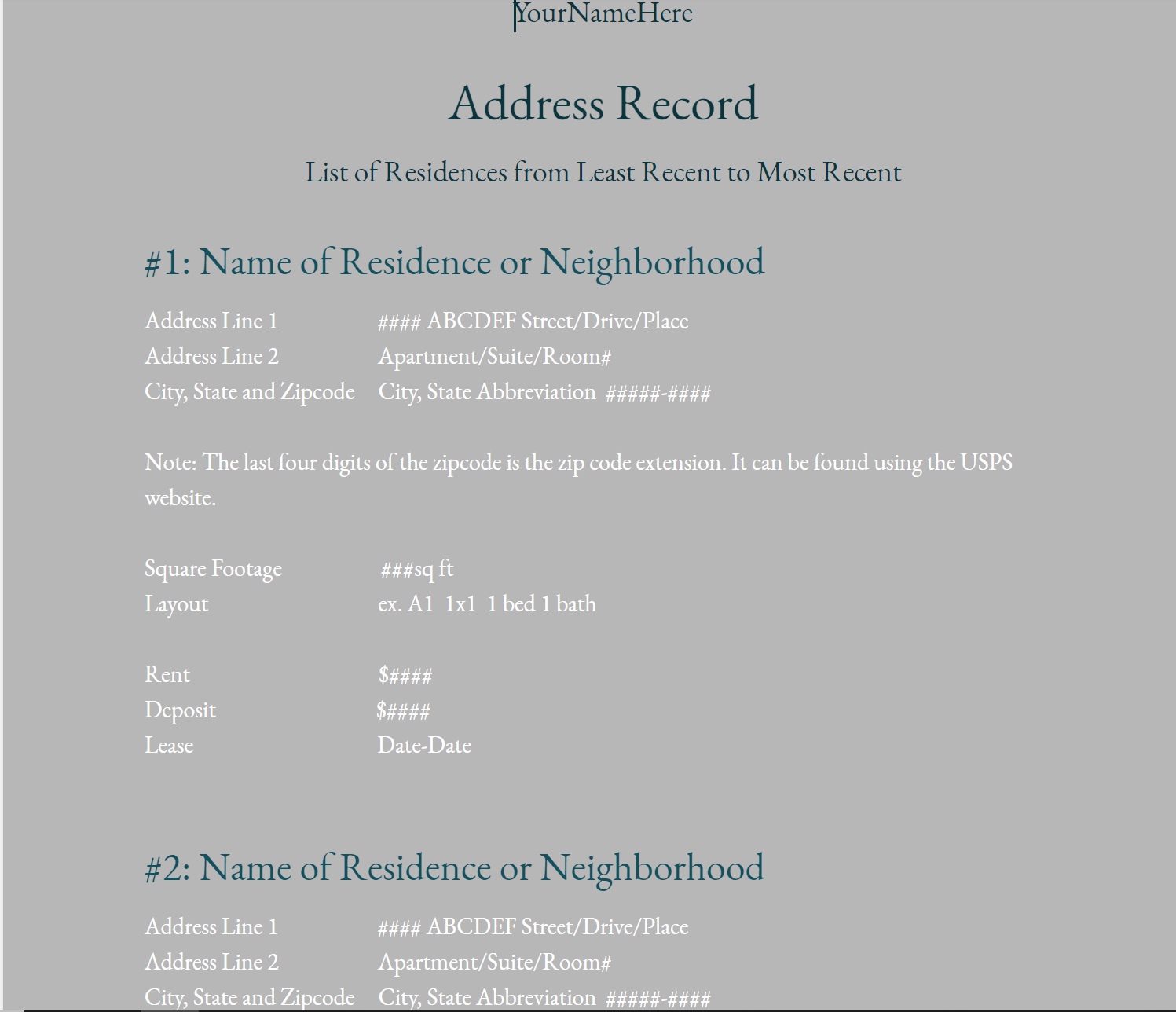
When applying to new jobs, apartments, houses, schools, ect., it is often necessary to list your previous places of residence. As we move through the years, we may find ourselves needing one place to reference the address of a place once lived, especially when requested to go back five years or more. Below is a downloadable address record google doc template . It includes spaces for details of addresses that may be useful to keep for future reference such as a zip code extension section, and floor plan details.

You can download it by clicking on the following: 

AddressRecordTemplate

It is useful to store it in the main drive or cloud for personal use. Here is a preview:


Share
Tweet
Pin
Share
No comments
Newer Posts

About ePS

About Me

Personal and Professional Organization | Templates and Checklists.

Follow Us

  • facebook
  • twitter
  • instagram
  • Google+
  • pinterest
  • youtube

Categories

recent posts

Sponsor

Facebook

Created with by ThemeXpose