• | Home |
  • | Professional |
    • CV
    • Resume
    • Letter
  • | Personal |
  • | Practical |
  • | Downloadables |
facebook twitter instagram pinterest bloglovin Email

Essentials P.S.


A Grocery Store Prosecco Taste Test: Which Bottle Is Worth Buying?

When you’re browsing the wine aisle at a grocery store or big-box retailer like Target or Total Wine, sparkling wine options can feel overwhelming. I wanted to simplify the choice by comparing several widely available Proseccos—the kind you’re most likely to find almost anywhere.

My goal was straightforward: compare price, flavor notes, and region to see which bottle delivered the best experience for everyday drinking.

What I discovered made this category particularly interesting.

Why Prosecco Is a Unique Category

Unlike some of my previous wine comparisons—like rosé, which spans multiple regions and styles—every bottle in this tasting shared a key distinction. Each was labeled DOC (Denominazione di Origine Controllata) from Italy.

DOC is apparently Italy’s regulated system for protecting regional wine production. In some ways, it’s similar to how the word Champagne is legally restricted to sparkling wine from the Champagne region of France.

That shared classification meant the wines started from a similar baseline. But their flavor profiles varied much more than I expected.

A Surprising Mini Bottle: Coppola

I’ve often thought of Coppola wines as a reliable standard for grocery store wine-good quality without being complex.

But the mini bottle I tried was surprisingly different.

My first impression was a bright, citrus flavor, almost like lime or grapefruit mixed with lemon. It had a sharp freshness that caught my attention. When I checked the bottle description afterward, the official notes were green apple and peach.

That didn’t quite match the citrus profile I initially perceived, but it helped explain the taste. The result was a unique flavor—pleasant, but not the fruit-forward style I expected from Prosecco.

The YouTube Recommendation: Mionetto

I first heard about Mionetto from a YouTube chef who recommended it as a go-to sparkling wine.

As one of my first ever prosecco buys, it turned out to be fruity, balanced, and extremely easy to drink.

The best way I could describe it was this: it tasted like fruit punch—not because of any one fruit flavor, but because multiple fruit notes blended together so smoothly.

The bottle lists golden apple, white peach, and honey, and those descriptors felt accurate. It had just enough sweetness and complexity without becoming heavy.

This ended up being my highest-rated wine in the tasting.

The Advertising Surprise: La Marca

La Marca is heavily advertised, and I’ll admit that heavy marketing sometimes makes me skeptical about quality.

It delivered exactly the fruit-forward flavor profile I had been hoping to find. To me, it tasted like tropical fruit—almost pineapple-like.

Interestingly, the bottle lists lemon and apple as its main notes. To me, those flavors combined have that rich sweetness that pineapple. I think that's what I was picking up.

In the end, La Marca was almost tied with Mionetto for my favorite.

The Most Unique: Kim Crawford

Kim Crawford produced the most unusual flavor profile of the group.

The first thing I noticed was a strong combination of red apple and green apple flavors. The contrast between those two types of apple created a distinctive taste—crisp but slightly sweet at the same time.

However, the bottle notes describe pear and tropical fruit, which didn’t fully align with what I experienced.

Even though it wasn’t exactly my preferred style, the wine really tasted high quality and well-made. I can easily imagine it being a favorite for many people.

Order

This small tasting reinforced something interesting about Prosecco: even when bottles share the same DOC classification and region, the flavor profiles can vary quite a lot.

Here’s how they ranked for me:

  1. Mionetto – Fruity, balanced, and easy to drink

  2. La Marca – Bright tropical flavor with great drinkability

  3. Kim Crawford – Unique profile, high quality

If you’re looking for a reliable grocery store Prosecco, Mionetto and La Marca both stand out as excellent choices.


Share
Tweet
Pin
Share
No comments

Many wine enthusiasts express an early interest in exploring the world of wine. From their early adult years, they often experiment with different bottles and learn what they can about the complexities within. A common challenge that arises when trying many wines over time is remembering which notes were most enjoyable, and how one bottle compared to another. To address this, some have turned to keeping tasting notes, categorizing wines into price ranges for easier comparison.

The main categories considered here are rosé, red, sparkling, and white. The focus is specifically on what might be called “grocery store wines”—those widely available at standard grocery stores, chains like Trader Joe’s, Target, Walmart, or even drugstores. While smaller boutique shops may offer excellent selections, the goal here is to identify reliable, accessible options. For rosé in particular, the aim was to find bottles that could be easily picked up on the way home, chilled, and brought to a gathering, barbeque, or casual evening. Many consumers begin with bottles under $9.99, seeking something simple, refreshing, and affordable—especially before a higher income makes splurging more practical. Rosé is often seen as a light, approachable summer wine that doesn’t require overly serious tasting rituals. Wines perceived as overly cheap or poor in quality were excluded, though many under-$10 rosés remain available for future exploration.

Among the bottles surveyed were Dark Horse, Emma Reichart, Charles Shaw (Trader Joe’s house brand), La Ferme Julien, Open Skies, Apothic, and La Vielle Ferme. Notably, none of these were considered outright bad. Each was ranked on a 1–10 scale, with the understanding that wines around $15 are often thought to represent the sweet spot for value and quality. Unsurprisingly, none reached the very highest tier, but several delivered enjoyable and well-balanced results within their price range.

Rosé is generally expected to be bright and light, with notes of red fruit such as strawberries, watermelon, raspberries, or cherries. Some are tart, some acidic, and others mellow. Many tasters favor brighter, more acidic profiles, though a mellow, medium-bodied rosé with watermelon notes and low acidity is sometimes preferred. Open Skies rosé emerged as a standout in this regard. It has been praised for its mellow character, marked by natural watermelon and floral rose notes with medium sweetness. The dark pink color and sleek, modern label add visual appeal, and the cork closure provides a classic touch. Beyond taste, its presentation makes it an attractive choice for gatherings or gifts—all for $8 at Target. However, one caveat is its limited availability; as a newer brand found only at Target, it may quickly disappear, as happens with many wine labels.

By contrast, La Vielle Ferme is one of the most consistently available rosés, stocked at grocery stores, Target, and Walmart. Its wide distribution makes sense after tasting: it is considered a reliable crowd-pleaser. While some reviewers rated it lower due to its relative mellowness, it occupies a middle ground among brighter rosés. Its defining characteristic is a raspberry note, which provides a balanced alternative to the sometimes clashing mix of strawberry and watermelon flavors. This lends it a slightly more sophisticated profile and a sense of higher quality. At $9.99, it sits at the top of this price category, though frequent sales bring it down to around $8. Its versatility makes it an excellent choice both on its own and as a base for sangria, where the raspberry note can be enhanced with fresh raspberries, simple syrup, or raspberry liqueur.


Share
Tweet
Pin
Share
No comments
Example of a Trello board being used for a personal schedule. A Trello dark ocean waves background is behind and icy image for the minimum daily schedule list of times and tasks.
Since sticking to a schedule can feel strict and sometimes inconvenient, a 'minimum' schedule can be used as a way to keep the comfort of freedom of time while balancing the basics. There are often a few things we make sure we do in our day that can guarantee a minimum level of health, handling responsibilities, and progress.
One of the changes in adulthood that can be very helpful is getting on a consistent sleep schedule. There are usually two problems with this: not having the freedom to stay up late for special occasions and not allowing for sleeping in when extra rest is needed. A 'rough minimum' could be setting the latest time for sleep and earliest time for waking up (barring logical things like staying up for New Years or waking up early for a flight). This way, it's encouraged to at least aim for a range of times. For example, instead of a typical time of going to sleep ranging from eleven at night to 3 in the morning, it might be eleven at night to one in the morning. In the case of waking up within certain time ranges, instead of it ranging between seven for some mornings all the way to twelve in the afternoon for others, having it range from eight to ten would be a gentle enough waking time. For example, if the latest bedtime is one in the morning, then waking at ten would mean allowing for up to nine hours of sleep, but even getting up at eight would be at least seven hours of sleep. It can be easier to keep a sleep time range than a sleep schedule, and therefore more likely for your body to get stable sleep. Naps can also be incorporated. Instead of sleeping in for five hours on the weekend, a minimum schedule could allow for two hours of sleeping in, with a three-hour nap in the early afternoon.
Morning routines are often pushed to be complicated and thorough, but on our less disciplined days, having a few minimums can help us practice habits that are important to us and help ourselves feel more pulled together on messy days. We all have our basic things we tend to skip over that can be good for us and beneficial for the rest of the day. For example, breakfast. If there's a habit of skipping breakfast, a good minimum could be keeping small bites to eat, leftovers, or snacks to take one to two bites of before leaving. If there's a goal set to meditate every day, shrinking the time down to one to two minutes can help at least make it a habit. If necessary, keeping to the basics such as showering and brushing teeth can take priority over everything else.
Having pre-work or school practices can be a way to gently keep habits that help set the day. Getting organized, preparing, or thinking about the most important tasks for the day can help remove a lot of stress over the hours to come. 
Balances of comfort of structure and provide the need for stability without the drool of discipline and the rebelling against discipline to lead to no schedule at all. Whether at home, resting on the weekend, or on vacation, having a consistent minimum schedule can help make stability an easier goal. Celebrating the repeats of even the smallest practices can assist our likelihood to do the same in the future. So can doing whatever we can to make those minimum steps easier. The health of our sleep schedules and body clocks can be helped along with gentleness. For example. using a sunrise alarm clock and allowing adequate time for each day to start off stable before all else hits. For the weekends, maybe allowing for an extra ten minutes to just get out of bed. For work schedule changes/time zone changes, trying to stay around the same time range makes these adjustments less to think about. These are ways to compensate for the times we don't feel like taking care of ourselves. Exercise dropping down to stretching. Hand cooked breakfast turning into a granola bar. It promotes healthier practices than nothing at all. Taking steps to take care of ourselves makes us feel more pt together and organized setting a better tone for each day.


Share
Tweet
Pin
Share
No comments

 Formally keeping track of a monthly budget over time helps to keep clear on your spending patterns and your financial history. At worst, it means having to write costs that are frustrating to think about and plan for, but at best, it's a way to see yourself being more organized and responsible. Having an aesthetically pleasing simple monthly budget to repeat gives peace of mind for having a solid record of your finances. One step is to just keep track of what your income is and how much you are spending and where. Here, a clear and proper budget breakdown is available for download. There are a few notes on the method used for this spreadsheet.

Download Here. EPS Budget Sheet.


Download Here. EPS Budget Sheet.

One strong rule of budgeting for each month is a rule of thirds. In this method, your housing is within one third of your monthly income, your expenses are kept to less than a third of your budget, and this way the last third is potential savings and investment income. 

For housing, likely the most essential part of a monthly personal budget, having it only cost a third of your income insures that, if times are harder, there is still enough of the budget available to devote to your place of living. This way, the most important thing is more likely to be taken care of. When applying to apartments, for example, they might want applicants to make three times the money of whatever the rent would be. In many cases, finding a residence where the cost is only a third of the average person's monthly income is difficult. The times of a person's income being able to match that rule in the current day housing market is becoming rarer.  Still, it is a good rule to aim for. This is considering all forms of housing: renting a room, renting an apartment, having a mortgage, etc. Also in this consideration are expenses that come with the housing. For example, mandatory renter's insurance, HOA fees, attached trash billings, etc. Often, an evaluation of whether or not to move out of a parental home might be if someone makes at least twice what their housing cost will be. There are exceptions, such as unusually high housing areas. For example, if your expenses are a very small fraction compared to how much you make, and you can afford to allocate more of your budget to housing. Within the housing budget, I include any separate storage fees, cost of PO boxes, if necessary, etc., as well as the expectation of potentially increasing costs such raised rent or increased property taxes on a yearly basis.

Bills are categorized here as any regular bills and cost such as electric (as well as water, sewer, and trash if not separated from the housing bill), internet, cell phone costs, car payments, and more. It's an area I would charge to things like subscription services or gasoline as well. In this budget sheet, bills are separated out from other expenses such as groceries and personal care items to split the budget into four sections instead of three. Their ratios can be very different.

It leads to the last third or fourth of a person's budget to being used for miscellaneous fees, whereas much of that is possible can be used for savings, retirement and more. Even here, further breaking miscellaneous into a fractional budget can help. For example, a third going to savings, a third going to safe investment, and a third going to retirement funds. There is a lot of variation that can be done especially here. There will also probably be changes continuously over time. For example, 100% of it could go to savings until there are 2-3 months of expenses saved in case of an emergency. Then, maybe 75% goes to debt such as student loans and credit cards and 25% to retirement. Maybe 50% goes into a separate savings for a new car, or a condo down payment.

Here are a few notes about the spreadsheet:

  • Have the google sheet set to 75% zoom to best see all the details in a quick glance.
  • The grid lines are off. They can be turned back on to better see the cells by going to View->Show-> and then selecting grid lines.
  • The font is cormarant garamond font with a default size of 12pt.

Download Here. EPS Budget Sheet.
Share
Tweet
Pin
Share
No comments

 Download here.


Share
Tweet
Pin
Share
No comments


Vehicle Record Keeper Template Preview

For Keeping Track of Previously Owned Cars and Other Vehicle's Identifications, Mechanical Work Done, and Address History

Download It by Clicking the Following Link:

Vehicle Record Keeper Template


Share
Tweet
Pin
Share
No comments

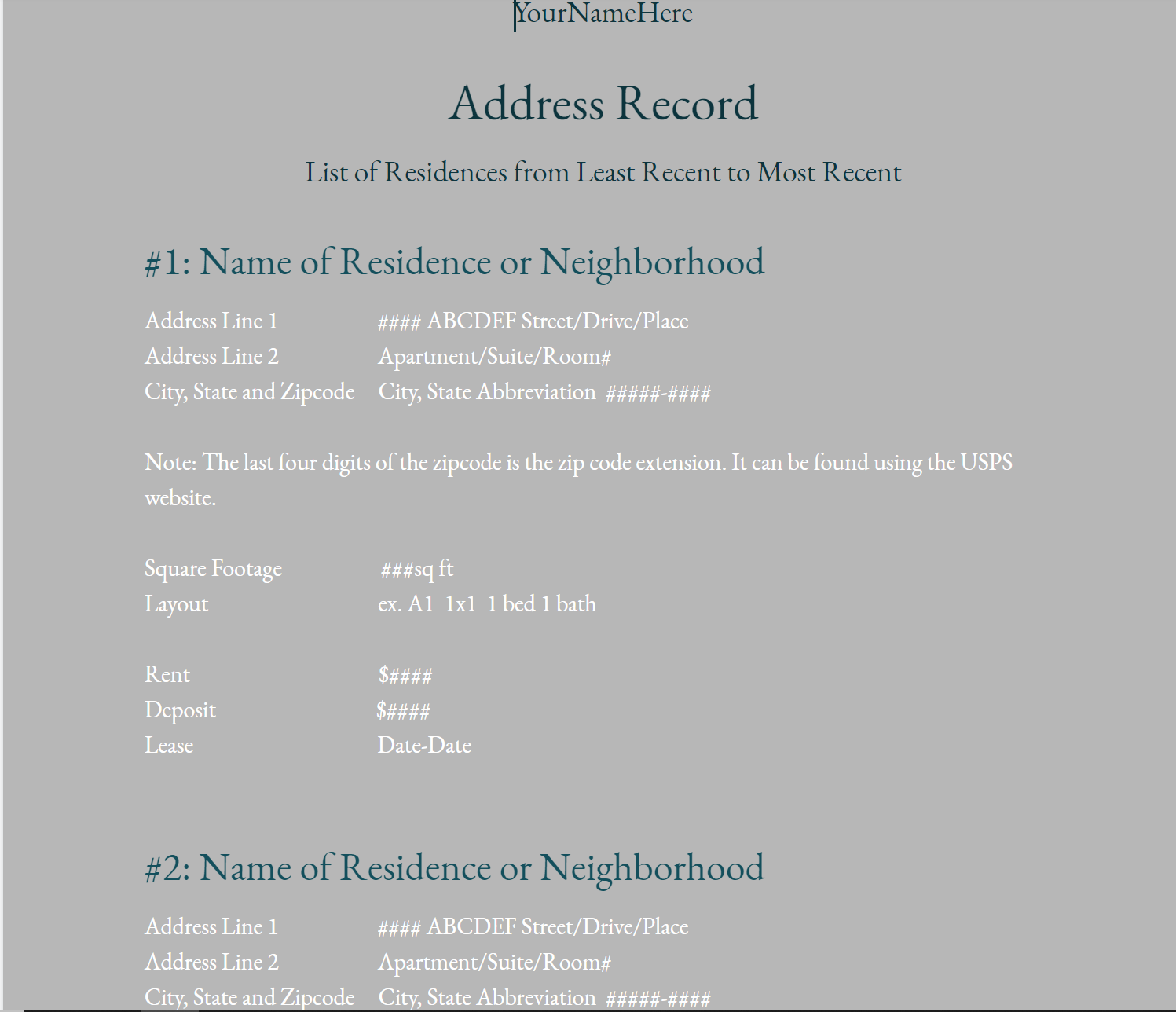
When applying to new jobs, apartments, houses, schools, ect., it is often necessary to list your previous places of residence. As we move through the years, we may find ourselves needing one place to reference the address of a place once lived, especially when requested to go back five years or more. Below is a downloadable address record google doc template . It includes spaces for details of addresses that may be useful to keep for future reference such as a zip code extension section, and floor plan details.

You can download it by clicking on the following: 

AddressRecordTemplate

It is useful to store it in the main drive or cloud for personal use. Here is a preview:


Share
Tweet
Pin
Share
No comments

About ePS

About Me

Personal and Professional Organization | Templates and Checklists.

Follow Us

  • facebook
  • twitter
  • instagram
  • Google+
  • pinterest
  • youtube

Categories

recent posts

Sponsor

Facebook

Created with by ThemeXpose